

This page was translated automatically using artificial intelligence (DeepL). The German version is binding. More information about automatic translation
News Intranet
This page was translated automatically using artificial intelligence (DeepL). The German version is binding. More information about automatic translation
The “Living Lab: Motion Simulation & Software Development”, launched by Professor Matthias Vodel in 2019, offers students, teaching staff and external interested parties the opportunity to experience top-class racing cars in a particularly high-resolution and highly detailed simulation. The “Living Lab” embodies interdisciplinary collaboration across the STEM degree programmes (Science, Technology, Engineering and Mathematics) at Mittweida University of Applied Sciences. What makes this collaboration special is its close practical relevance and the immediate connection between the results and the experience of one’s own work. The results achieved through this joint effort inspire people of all generations, which naturally boosts the university’s public profile and will hopefully attract many young people to study engineering at Mittweida University of Applied Sciences.
It has been a long journey to develop such sophisticated simulators as those on display today in the “Living Lab”. Upon entering the laboratory in Building 6-001, the history of the simulators built over the years is clearly evident: Starting with simulators that provide driver feedback using just two linear motors, right through to hardware equipped with a high-performance four-piston system capable of reproducing driving behaviour almost in real time. Furthermore, the latest generations of driving simulators feature a wide range of additional tactile modules and steering systems capable of realistically simulating even the strongest steering forces. The seat platform can also be moved freely in both the longitudinal and lateral directions to simulate the vehicle’s oversteer and understeer (traction-loss platform). What’s more, the Recaro racing seats – taken from a real racing car – quickly make the user forget that this is ‘just’ a simulation.
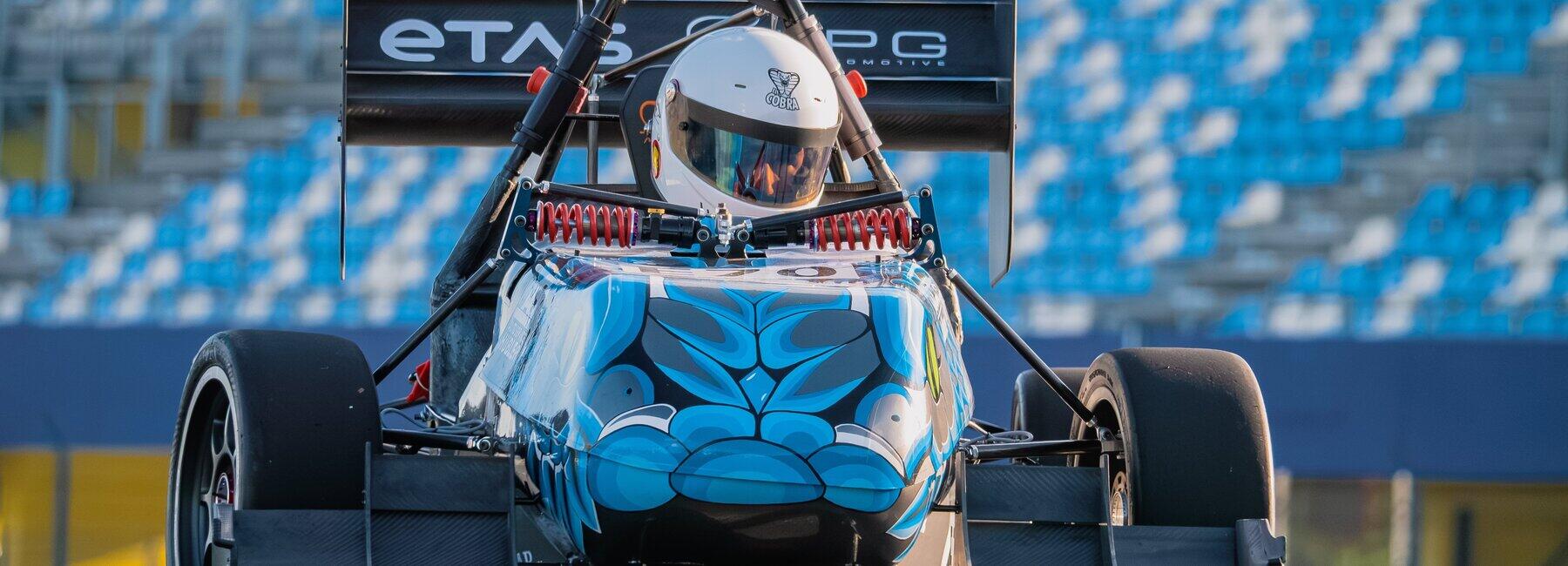
At its current stage of development, the Living Lab has several customised simulation models from various vehicle manufacturers, which have been measured in real life and subsequently tailored specifically to the technical platforms. Until now, the simulators themselves have focused on ergonomic requirements from the touring car category, primarily concerning the seating position and the layout of the controls. To broaden this scope, the Formula Student team at Mittweida University of Applied Sciences, Technikum Mittweida Motorsport (TMM), is now making available the race car they built themselves from the previous season. This car has been refurbished so that the relevant hardware components, which were developed specifically for formula racing cars, can be connected.
The TMM is a project run by the INW Faculty and is led by Professors Frank Weidermann and Lutz Rauchfuß. Following in the footsteps of the former engineer and Mittweida student August Horch, participants from all faculties and degree programmes have been working in this team since 2006 to develop racing cars for ‘Formula Student’ – a competition for self-developed vehicles in the field of engineering. Here, students with a passion for motorsport independently design and build single-seater racing cars and then compete in various disciplines at national and international level.
Following numerous internal combustion engine models, the TMM has been focusing on the development of electric racing cars since 2016. The racing car, the Black Mamba, which has now been handed over to the Living Lab, was unveiled to the public for the first time in 2021. The vehicle, which is just under three metres long and weighs 256 kilograms including all components, was powered by a 68-kilowatt motor delivering up to 80 Newton metres of torque. Other highlights included – and still include – the in-house developed 412-volt lithium-ion high-voltage battery and the flax fibre bodywork, which was recognised for its environmental friendliness in the previous racing car. Following various challenges during the Covid-19 pandemic, last year’s participation of the Black Mamba in Formula Student Germany at the Hockenheimring and in Formula Student Netherlands in Assen is seen as a fresh start for the motorsport team. TMM is currently in the final stages of completing what is now its third electric racing car, which is set to compete in further Formula Student racing events in 2025.
Further information about TMM can be found at https://www.tm-motorsport.net/.
This extension of the “Living Labs” is not only intended to give keen motorsport enthusiasts the chance to take the driver’s seat in such a racing car, but also supports the research project currently being led by Professor Vodel, entitled “Telemetry-based ML data analysis & configuration management in the field of automotive simulation”. This project focuses primarily on collecting vehicle data from motor racing, road traffic and simulations, and analysing and evaluating it using AI-supported processes. At the same time, the TMM intends to use the new simulator to improve the training of its racing drivers.